Charles White Across Media: A Visual Archive
November 6, 2026 - January 31, 2027
(gallery closed Nov 28-29th and Dec 12-Jan 2 for Holiday Breaks)
Opening Reception
Friday, November 6th
6-8PM
A Curator-Led Tour with Ian White
Saturday, November 7 | 10AM
Grandpa and the Library: How Charles White Learned to Paint for Family Saturday
Saturday, November 7th | 3PM
Logan Center Gallery
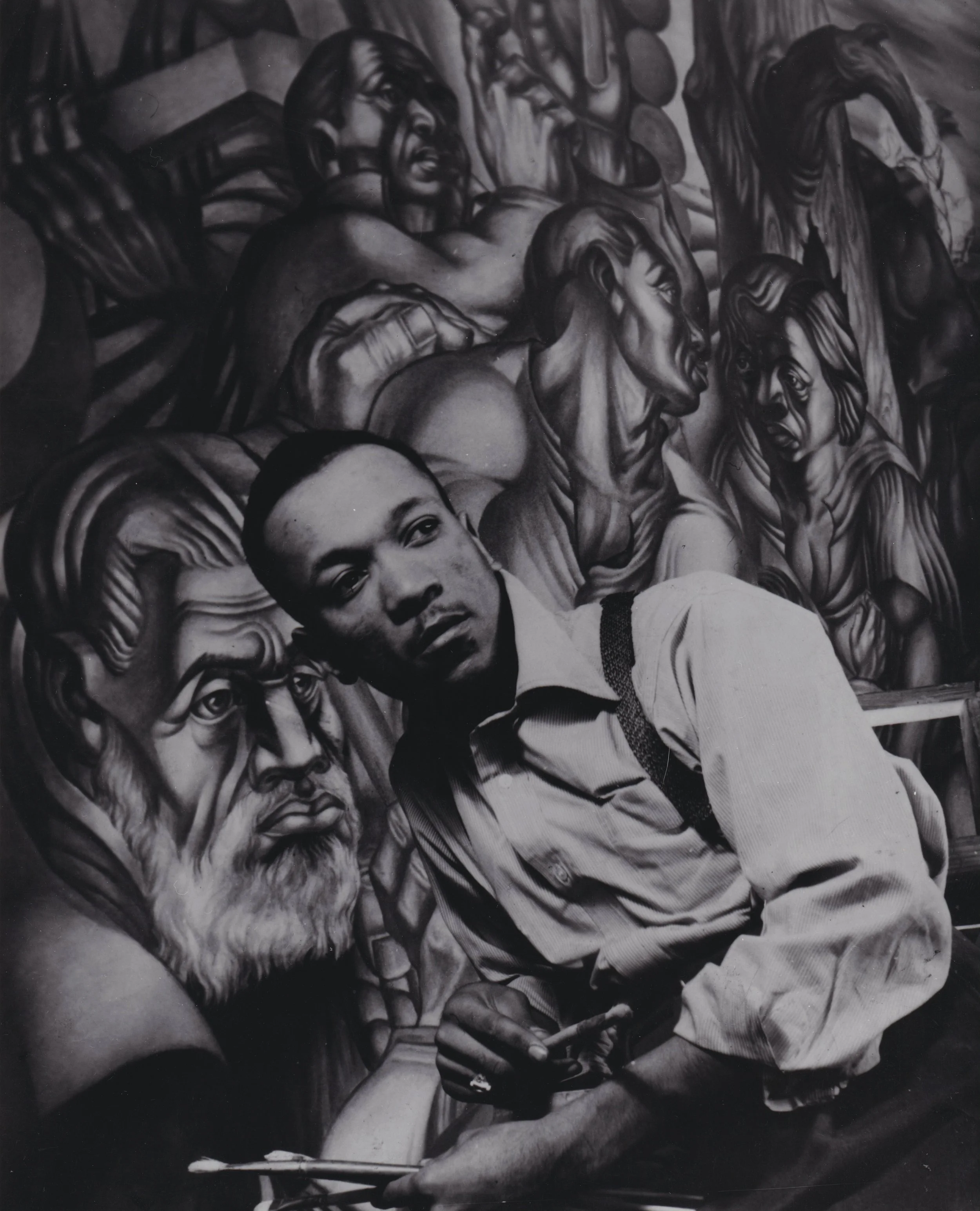
Charles White in front of his Chaos of the American Negro mural in Chicago, 1941. Courtesy of the Charles White Archives and the Gordon Parks Foundation. Photograph by Gordon Parks.
Charles White Across Media: A Visual Archive brings together album covers, book jackets, magazines, film stills, photographs, prints, and other ephemera featuring the work of Charles White (1918-1979) to examine the expansive cultural life of his imagery. Tracing how his work circulated beyond the studio and the museum wall, the exhibition reveals how White’s images centered everyday life and shaped a broader visual language.
An artist who worked fluidly across drawing, painting, printmaking, and mural-making, White created what he described as “powerful images of dignity”, centering African-American experiences as well as historical figures and events at a time when such representations were widely distorted or excluded from mainstream culture. These opportunities for reproduction arose through active collaboration with musicians, writers, and filmmakers. White’s images were adapted, printed, and distributed across a wide range of media, crossing disciplines and communities to become part of a shared cultural consciousness.
By foregrounding circulation alongside creation, the exhibition invites visitors to consider how White’s work contributed to the formation of a Black visual canon. His images did not remain fixed objects behind glass — they became living symbols, connecting people, histories, and communities through a sustained commitment to representation, relationships, and what White himself understood as a sense of oneness.
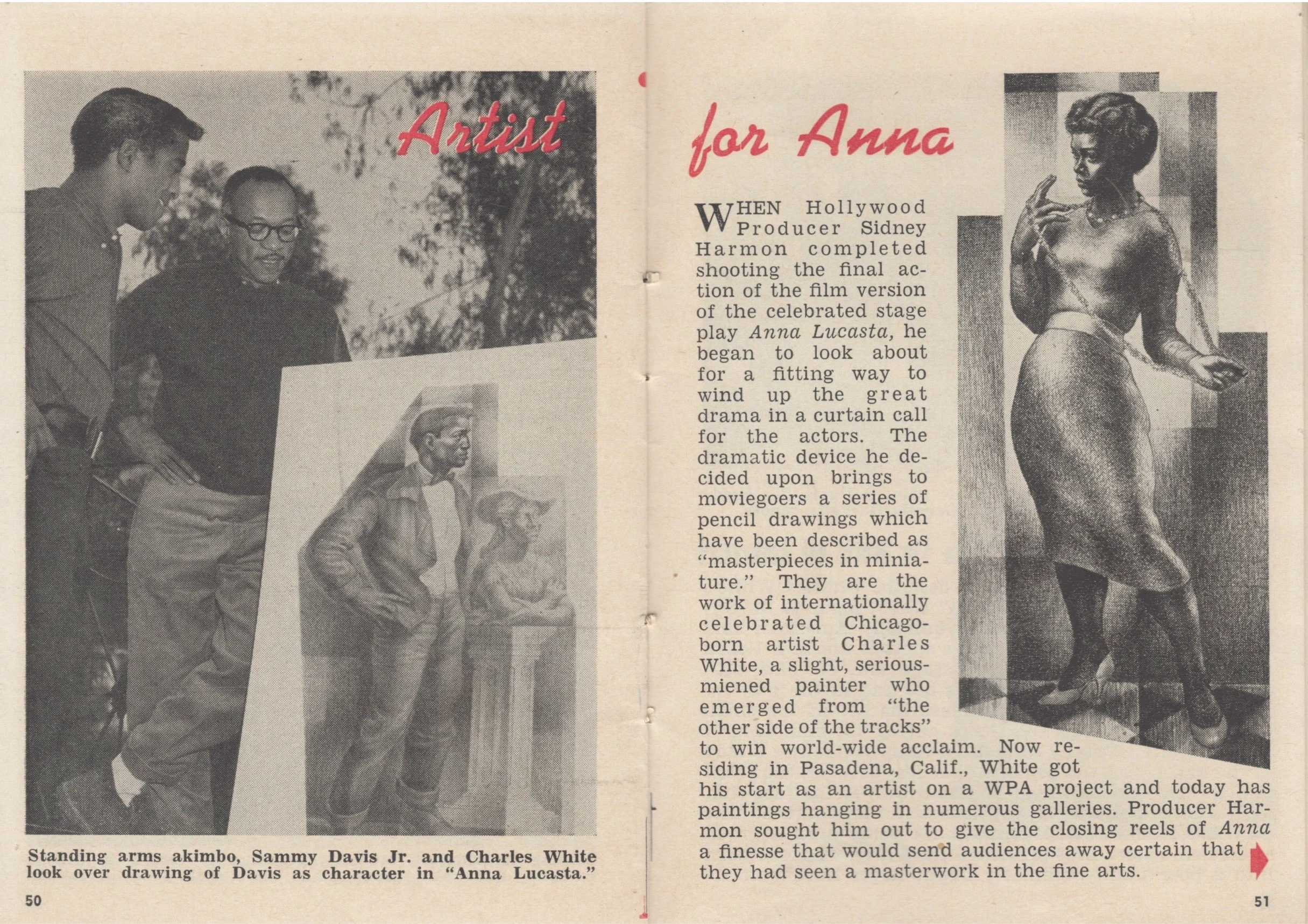
“Artist for Anna,” Hue Magazine vol. 6, no. 4 (Feb. 1959): 50-51.
Charles White Across Media: A Visual Archive is a special initiative of the Charles White Archives presented by Logan Center Exhibitions and the South Side Community Art Center. The exhibition is curated by Ian White with curatorial support by Paulina Alvarez, Jan Brugger, and jada-amina. Additional support is provided by the Ng Family Visiting Artist Fund, the Revada Foundation, and Friends of the Logan Center.

ABOUT CHARLES WHITE
Charles W. White (1918–1979) is known for his powerful depictions of African American life and the human condition. A draftsman, painter, printmaker, and muralist born and raised in Chicago, he also lived in New York and Los Angeles, becoming a vital presence in each city’s creative community as an artist, activist, and educator.
As a child, he spent formative time in both Chicago and the South, deepening his engagement with Black culture, life, and history. At the Chicago Public Library, he developed a love of reading and was introduced to the Harlem Renaissance through Alain Locke’s seminal text, The New Negro. His early exposure to art and disciplined technique informed his artistic practice and broader cultural engagement.
White received a scholarship to attend the School of the Art Institute in 1937 and shortly after, the Illinois Art Project, a state affiliate of the Works Progress Administration, commissioned him to paint a mural. White’s There Were No Crops This Year won first prize at the 1940 American Negro Exposition and appeared on the cover of the exposition’s Henry O. Tanner Gallery catalog. At the same time, the Associated Negro Press commissioned his History of the Negro Press mural for their exhibit at the exposition. Determined to employ art in the struggle for social change, White created dignified portrayals through figurative representation, scale, and form. Other prominent public works include The Contribution of the Negro to American Democracy, which depicts notable African Americans throughout history. He saw art as a vehicle for social activism: “Art must be an integral part of the struggle. It can’t simply mirror what’s taking place. It must adapt itself to human needs. It must ally itself with the forces of liberation.”
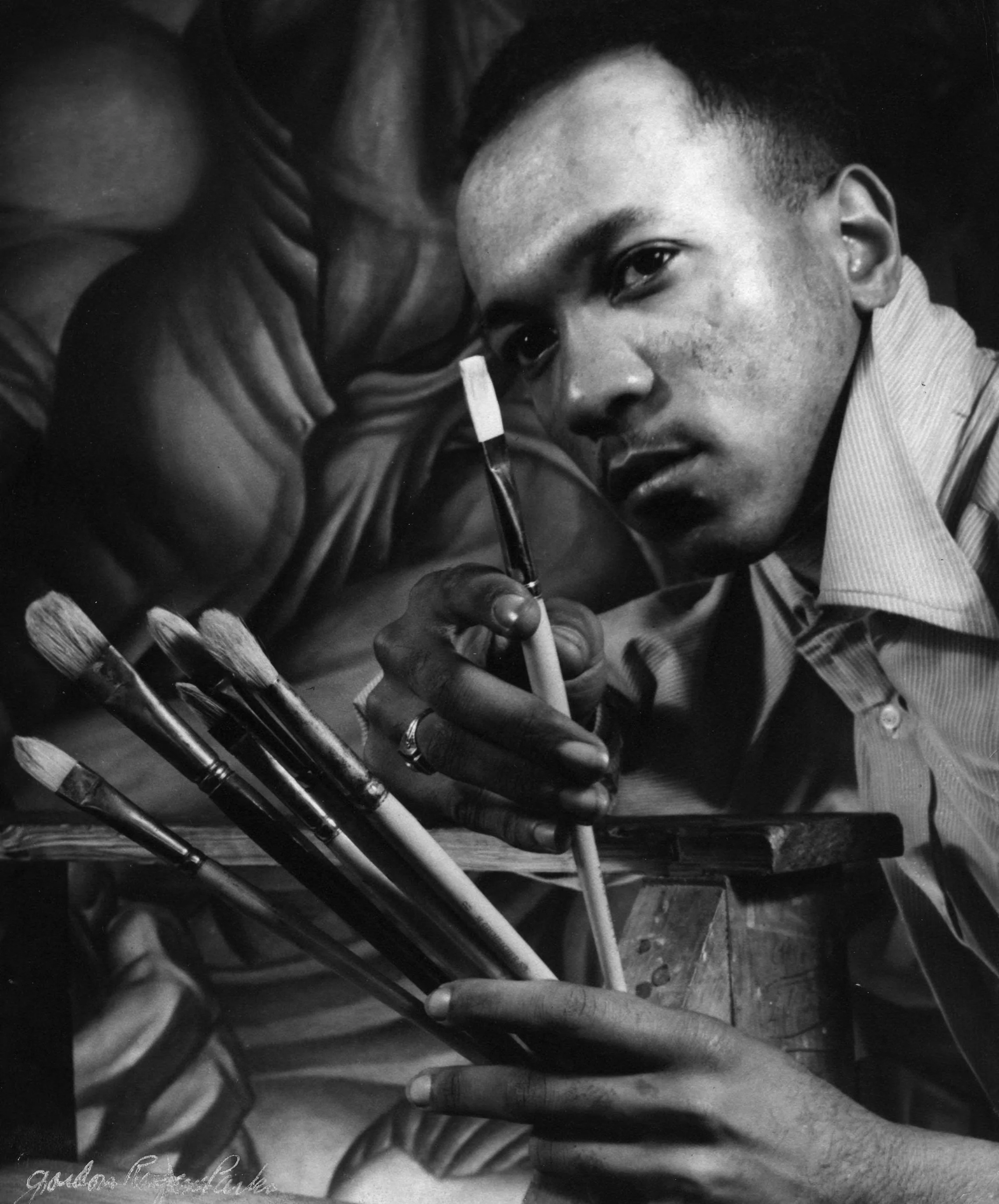
Charles White in front of his Chaos of the American Negro mural in Chicago, 1941. Courtesy of the Charles White Archives and the Gordon Parks Foundation. Photograph by Gordon Parks.
White left Chicago for New Orleans briefly before moving to New York with his first wife, artist Elizabeth Catlett. There, he joined the ranks of important African American artists and intellectuals of the time, including Langston Hughes, Jacob Lawrence, and W. E. B. DuBois. White's artistic work was interrupted briefly in 1944 when he was drafted into the military. He traveled with Catlett to Mexico City, where they stayed at the home of David Alfaro Siqueiros and met master muralists Diego Rivera, José Clemente Orozco, and Pablo O'Higgins. White honed his printmaking skills at the workshop Taller de Gráfica Popular, which made him an honorary member some years later. After White and Catlett divorced, he returned to New York. He remarried social worker Frances Barrett, a white woman, at a time when interracial marriage was still illegal in many parts of the country. He continued working with the Committee for the Negro Arts and the Workshop for Graphic Art until 1956, when illness led him to relocate.
White arrived in Los Angeles, bringing with him the relationships he had cultivated with artists, musicians, writers, and actors. Exhibitions of his work became more frequent abroad and across the United States. He collaborated on television and film projects, including Anna Lucasta (1958) and An Evening With Belafonte (1957), for which he received an Emmy nomination. His work was also woven into film storylines, including Sidney Poitier’s Guess Who’s Coming to Dinner (1967) and For the Love of Ivy (1968). In 1965, White received a Grammy nomination for Best Album Cover – Graphic Arts for his album cover of Contemporary American Masterpieces: Gould: Spirituals for Orchestra; Copland: Dance Symphony.
Before moving to Los Angeles, White taught for three decades, but as Head of the Drawing Department at Otis College of Art and Design, he influenced a generation of artists and solidified his legacy as an educator and mentor. His former students include Kerry James Marshall, David Hammons, Ulysses Jenkins, Suzanne Jackson, Judithe Hernández, Alonzo Davis, John Biggers, Bas Jan Ader, and Corky McCoy, among many others. One of the most important artists of his time, White nurtured some of the most significant artists of ours.
ABOUT IAN WHITE
Ian White is a visual artist, curator, and educator who lives in Los Angeles and is the chief executive of The Charles White Archives. His artistic practice includes narrative murals, abstract sculpture, installations, and more. White was influenced by his father, Charles White, a significant figure in twentieth-century art and the community of artists, musicians, actors, and activists in which he was raised.
White wrote and illustrated Grandpa and the Library: How Charles White Learned to Paint, for The Museum of Modern Art, New York, and curated an exhibition at the Los Angeles County Museum of Art, Life Model: Charles White and His Students. He was an assistant curator for Monumental Practice: Charles White at David Zwirner Gallery, New York, and Charles White — Leonardo da Vinci at The Museum of Modern Art, New York. He is developing a civic art intervention with the Los Angeles County Department of Parks & Recreation and Arts and Culture at Charles White Park in Altadena, CA.
PROGRAMMING:
Opening Reception
Friday, November 6
6-8PM
RSVP
A Curator-Led Tour with Ian White
Saturday, November 7 | 10AM
Register
This event is free and open to the public, but registration is required.
Join Ian White, artist and son of Charles White, for a special look at Charles White Across Media: A Visual Archive. White will offer a personal perspective on how his father’s work appeared across media. Don’t miss this tour, told through the eyes of White’s son and living steward of his legacy.
Drawing Sound: Charles White, Craig Taborn, and the Black Arts Tradition
Saturday, November 7 | 1-2PM
Screening Room 201 (2nd Floor)
Register
This event is free and open to the public, but registration is required.
A special program with Craig Taborn and Ian White on the creative legacies of the Black Arts Movement featuring a musical demonstration and conversation, in collaboration with Logan Center Exhibitions, UChicago Department of Music, and UChicago Presents.
Pianist and composer Craig Taborn, the 2026-27 Don Michael Randel Ensemble-in-Residence, joins Ian White, son of artist Charles White, for a considered exploration of the ways Black artistic legacies are made and remade across mediums.
Taborn will illustrate his creative process in a live demo, playing excerpts from compositions and discussing the musical ideas and theories behind them. He’ll draw connections between his work and Charles White Across Media: A Visual Archive, on view in Logan Center Exhibitions this fall. Taborn and Ian White will place Charles White’s art within a broader fabric of Black artistic and intellectual history, exploring how artists metabolize histories of struggle, creativity, and collective memory into individual expression.
Grandpa and the Library: How Charles White Learned to Paint for Family Saturday
Saturday, November 7th | 3PM
Logan Center Gallery
RSVP
Free and open to the public
Join us for a reading of Grandpa and the Library: How Charles White Learned to Paint with author Ian White as part of Logan Center's Family Saturday.
This charming children’s book follows the young Charles White as he goes to the library every day to look at picture books and watch the people around him. Later he draws what he has seen on scraps of paper. Over time he learns to be patient and observant, and, by watching art students painting in the park, he learns how to mix and use oil paints. As he grows up, Charles creates powerful portraits of the figures he sees and admires—of his family as well as of African American musicians, thinkers, scientists, and civil rights leaders. By telling his own stories and those of others, he becomes an artist.
Written and illustrated by his son, C. Ian White, and featuring full-color reproductions of Charles White’s own artworks, this deeply personal story traces the childhood influences that inspired young Charles to become an artist and a teacher.
BACKGROUND:
The exhibition expands on a 2025 symposium co-organized by the Hyde Park Jazz Festival, Logan Center, South Side Community Art Center, and UChicago Presents. “Between Sound and Sight: Mapping the Sonic Imprints of Charles White's Vision”, in conjunction with a performance by Gerald Clayton, explored the interstices where sound, image, and history converge. Charles White’s multi-dimensional legacy was celebrated through panels and dialogue, demonstrating how White’s sonic presence—whether through album covers, murals, or his relationships with musicians—continues to reverberate across the cultural landscape.
PRESENTING PARTNERS:
Charles White Archives
The Charles White Archives, based in Altadena, California, is led by Ian White, son of renowned artist Charles White (1918–1979). Dedicated to preserving and advancing his father's artistic legacy, the archives also fosters broader cultural impact through special initiatives. This stewardship extends to Charles White’s former students, contemporaries, and other creative contributors historically excluded from the canon.
Logan Center Exhibitions
Logan Center Exhibitions presents international contemporary art programming at the Logan Center Gallery and throughout the Reva and David Logan Center for the Arts at the University of Chicago. Reflecting the spirit of inquiry at the university, Logan Center Exhibitions focuses on open, collaborative, and process-based approaches to cultural production. Working closely with artists, students, scholars, and community members, Logan Center Exhibitions presents innovative exhibitions by emerging and established artists; supports ambitious new commissions and research projects; disseminates knowledge through publications; and facilitates connections through talks and other public programs.
South Side Community Art Center (SSCAC)
Founded in 1940, SSCAC is the oldest African American art center in the United States and is a Chicago Historic Landmark. While taking pride in our rich past, we today build on our legacy and innovatively serve as an artist- and community-centered resource with programs, exhibitions and events that inspire.
SSCAC showcases established artists and nurtures emerging creators. Through educational and artistic programs, exhibitions, talks, tours, and more, the center strives to engage, educate and connect community members to African American art and artists.